The Age of Proactive AI
Chat made intelligence cheap. Proactive agents make attention and authority scarce. A practical Grok Bot vs Instinct vs Muse comparison — and how to choose.
For a few years, "using AI" mostly meant opening a chat window and asking a question. That era isn't over — but it just stopped being the interesting one.
In a few weeks we got a clearer wave of personal agents that don't wait to be asked: Instinct, Meta's Muse, and Grok Bot (and more will follow; ChatGPT will eventually ship its own cut of this). Maail Rasheed put it cleanly on LinkedIn: the shift is from asking AI for things to AI knowing when it should come to us.
This post is a practical read on that shift — and a direct Grok Bot vs Instinct vs Muse comparison for operators who have to pick where to put trust, budget, and workflow.
What "proactive" actually means
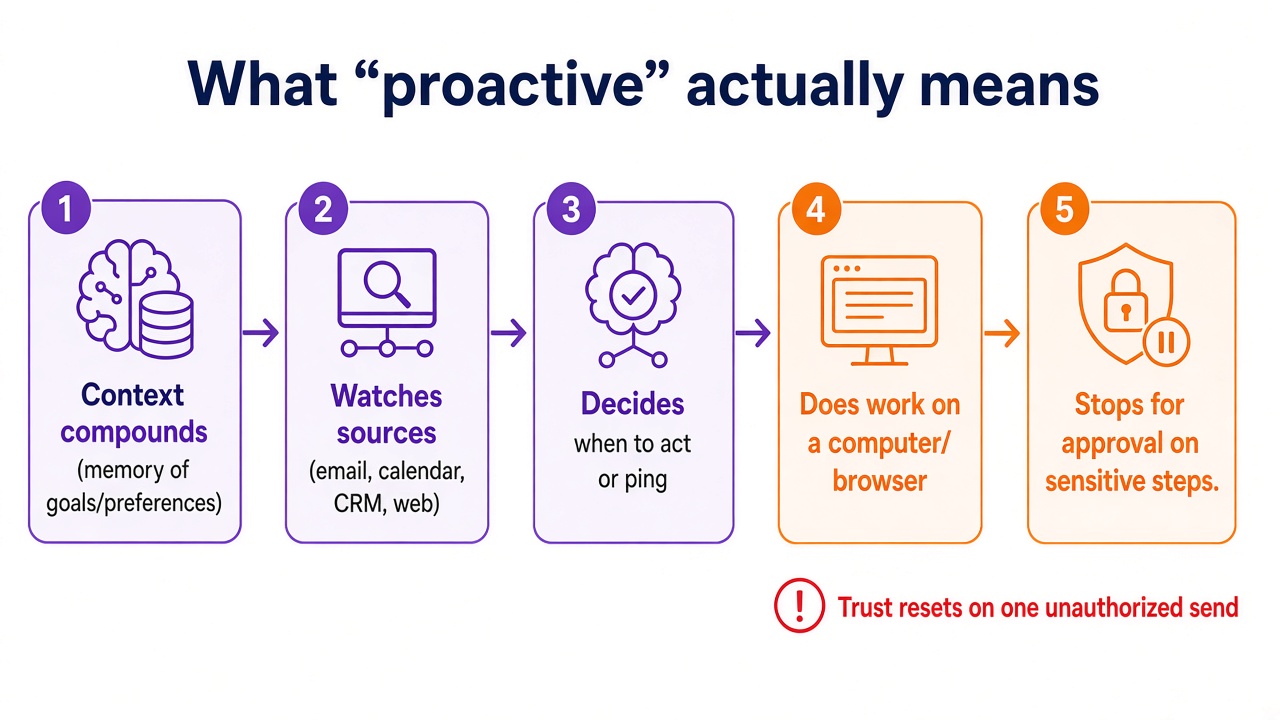
Proactive doesn't mean spammy. It means the agent has enough durable context to notice when something matters, do work in real tools, and interrupt you only when the cost of silence is higher than the cost of a ping.
Five pieces show up in every serious product:
- Context that compounds — goals, preferences, and prior decisions survive past one thread
- Watchers — email, calendar, CRM, tickets, the open web
- Judgment to act or ping — not every change deserves a notification
- A computer — browser, files, sometimes phone-like control, so work finishes outside chat
- A stop line — sensitive actions (send, spend, delete, production change) wait for you
Miss #5 and you don't have a teammate. You have a liability with a chat UI.
Grok Bot vs Instinct vs Muse
These three are not clones. They're three bets on who the agent is for and how trust is enforced.
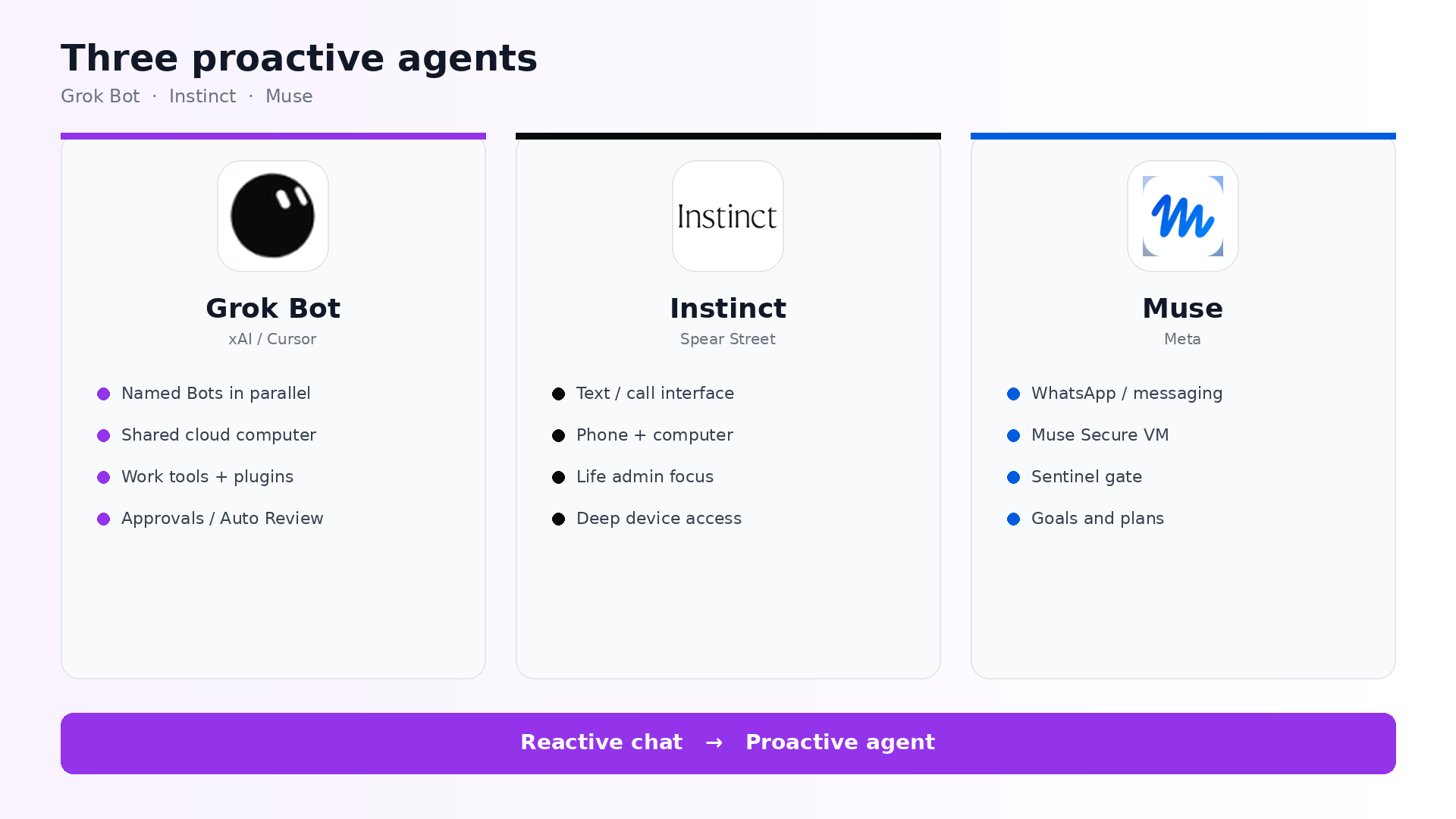
| Grok Bot (xAI / Cursor) | Instinct (Spear Street) | Muse (Meta) | |
|---|---|---|---|
| Primary job | AI teammates for work that spans your tools | Life-admin personal assistant you text or call | Consumer personal agent for goals + daily tasks |
| Interface | Desktop + iOS app; message named Bots | SMS / WhatsApp / call — "no new UI" | Muse app + WhatsApp (+ glasses later) |
| Compute model | Persistent shared cloud computer (browser, filesystem, terminal) across your Bots | Persistent cloud computer + deep device hooks (email, messaging, screen, audio, location, …) | Per-person Muse Secure VM with its own browser |
| Multiplicity | Many named Bots in parallel, handoffs between them | One personal assistant persona | One Muse per person |
| Proactivity style | Routines, skills, Bots that keep role memory and come back for approval | Follows dropped threads; can call/text you; owns bookings, inbox, rides, vendors | Remembers what matters; suggests unprompted; advances goals while the app is closed |
| Trust / safety story | Cursor SSO/privacy mode; Auto Review for sensitive actions; you take over the computer for passwords | Early praise for capability; TechCrunch and early users flagged broad ToS licenses, retained mail after disconnect, phishing risk, and at least one unauthorized send | Sentinel gate on egress; credentials kept out of Muse's view; audit trail; scoped app access; Confidential VM (user-held keys) promised later |
| Access today | Included with paid Cursor plans / Teams, or SuperGrok link | Invite / private access (spreading via invites) | Rolling out in the US (iOS, Android, muse.ai); free tier + paid for heavier use |
| Best default use | Work queues: outbound drafts, inbox triage, bug repro, product digests, chief-of-staff briefs | Personal ops: travel, reservations, bill follow-ups, family scheduling | Consumer goals + everyday tasks inside Meta's messaging surface |
Grok Bot — proactive work staffing
Grok Bot is the one I'd staff like a junior team. You create focused Bots (outbound, inbox, product performance), hand them scoped tasks, and keep send/spend/prod behind approval. Several Bots can run in parallel on one shared computer and pass work between themselves. I wrote a full install-to-first-handoff guide here: Getting Started with Grok Bot.
If your pain is "this spans CRM + Slack + browser + a report by morning," Grok Bot is the clearest fit among the three.
Instinct — proactive life admin over text
Instinct's product bet is form factor: you already live in Messages. Text or call it; it uses a phone and a computer the way a person would. Early users rave about bookings, rebookings, inbox cleanup, and follow-ups that used to eat evenings.
The counterweight is trust debt. TechCrunch's August 24 write-up collected the early scars: broad "perpetual and irrevocable" license language in the ToS, device signal collection (including screen/input), retained Gmail content after disconnect for some testers, phishing experiments that succeeded, and at least one email sent without prior check. Instinct later told the press it was taking the security concerns seriously — and the product is still early/private. Capability is not the open question. Governance is.
Muse — proactive consumer agent with a security thesis
Meta's Muse pitch is scale plus a purpose-built secure computer. Each person gets a Muse Secure VM. A separate Sentinel agent sits apart from Muse and is the permission authority for network egress and connector actions. Muse isn't supposed to see your real passwords or payment methods; Link (Stripe) adds one-time cards and purchase protections for agent checkout. Later, Muse Confidential VM aims for encryption with a key only you hold.
That's Meta arguing — correctly — that personal agents need a new trust architecture, not just a clever prompt. Whether you buy Meta as the custodian of that architecture is a separate decision from whether the design is serious. The design is serious.
How I'd choose (operators, not hype)
| If you need… | Start with… | Why |
|---|---|---|
| Named work roles, parallel Bots, Cursor/tooling stack | Grok Bot | Built for multi-Bot work handoffs and reviewable deliverables |
| Text-native life admin and you're invite-eligible | Instinct | Best "message it like a person" loop — if you accept the privacy trade after reading the ToS yourself |
| WhatsApp-native consumer agent + explicit Sentinel/VM story | Muse | Clearest published consumer security architecture of the three |
| Anything that sends mail, spends money, or touches production | Any of them — with a hard stop line | One unauthorized send resets trust to zero |
A useful rule from the field: start every Bot/agent on read-and-prepare work. Promote to "send / book / buy" only after you've seen failure modes and set the approval boundary in writing (in the Bot description, or in Muse/Instinct's permission scopes).
The real shift
Chat made intelligence cheap. Proactive agents make attention and authority the scarce resources.
Whoever wins this category won't just have a better model. They'll win on:
- how little you have to re-explain yourself
- how safely credentials and payments are held
- how boringly reliable the approval story is when something goes wrong
We're early. The products above will change week to week. The evaluation checklist won't: context, watchers, computer, stop line, audit trail.
If you're rolling agents into a company, treat them like staffing with production access — because that's what they are.
References
- Personal AI Agents Learn to Proactively Assist — LinkedIn
- Muse product page (Meta AI)
- Introducing Muse — Meta Newsroom
- Instinct's powerful AI assistant is raising privacy and security concerns — TechCrunch
- Instinct (product)
- Reddit thread: Instinct AI for life admin
- Related on this site: Getting Started with Grok Bot
Enjoyed this? Let's work together.
I help companies turn AI strategy into shipped, revenue-generating products.