Laya vs Jev: Choosing a System 1 Decision Engine
Jev made System 1 a function call. Laya made it open weights. A practical comparison — same Choice/Score/Noul shape, different tradeoffs — and how I'd choose.
Most production AI features aren't chat. They're decisions buried in code: route this ticket, score this lead, gate this prompt, escalate when confidence is low.
TypeSafe's Jev made that interface public: unstructured state in, typed Choice / Score / Noul answers out, with calibrated probabilities, in roughly 70–500ms. I walked through the shape here: Getting Started with Jev.
Days later, an open-weights answer showed up. Laya (Convai Innovations) is a non-autoregressive System 1 decision engine you can pip install, host yourself under Apache 2.0, and point at the same class of questions — including a Jev-compatible POST /v1/systemone server if you already have TypeSafe-shaped clients.
This post is a practical Laya vs Jev read for operators: what they share, where the numbers diverge, and how I'd choose.
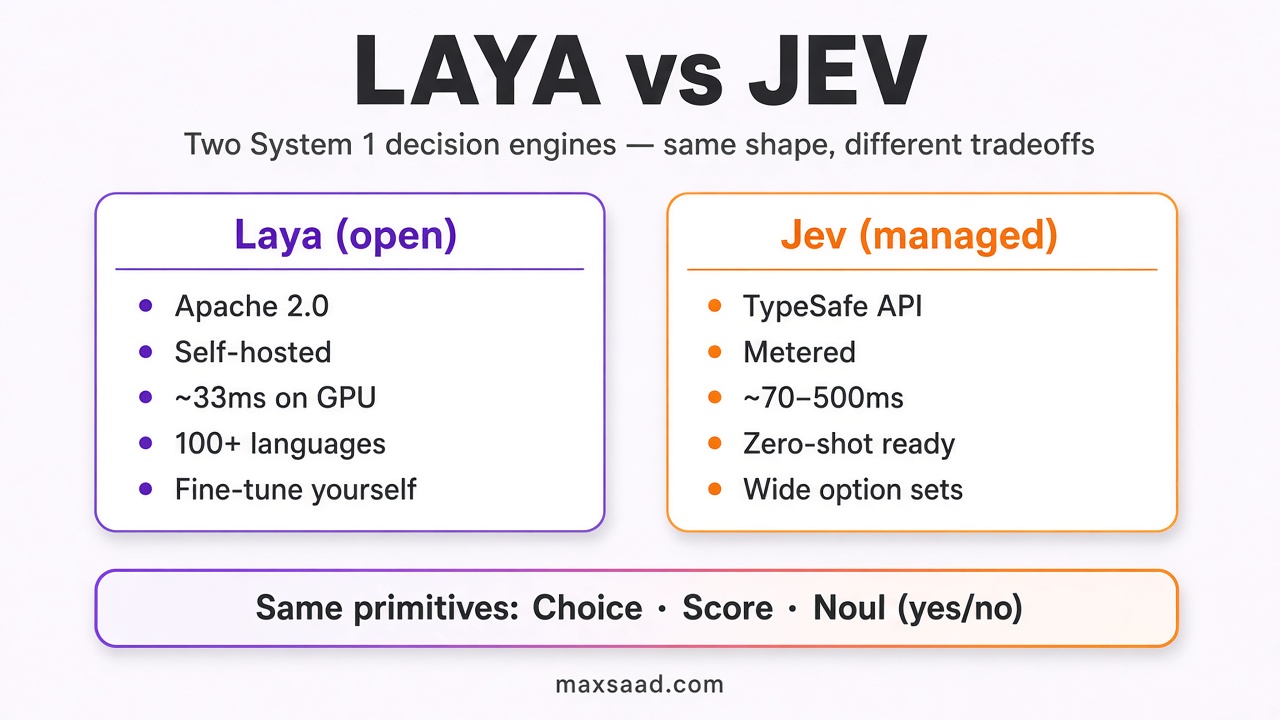
Same job, different delivery
Both refuse to write prose. You send a state (ticket, email, JSON) plus typed questions; you get probabilities you can branch on.
| Primitive | What you get |
|---|---|
| Choice | One option from a dictionary you define + full probability mass |
| Score | Ordinal rubric (e.g. urgency 0–3) + confidence |
| Noul | Yes/no-ish with calibrated P(true) |
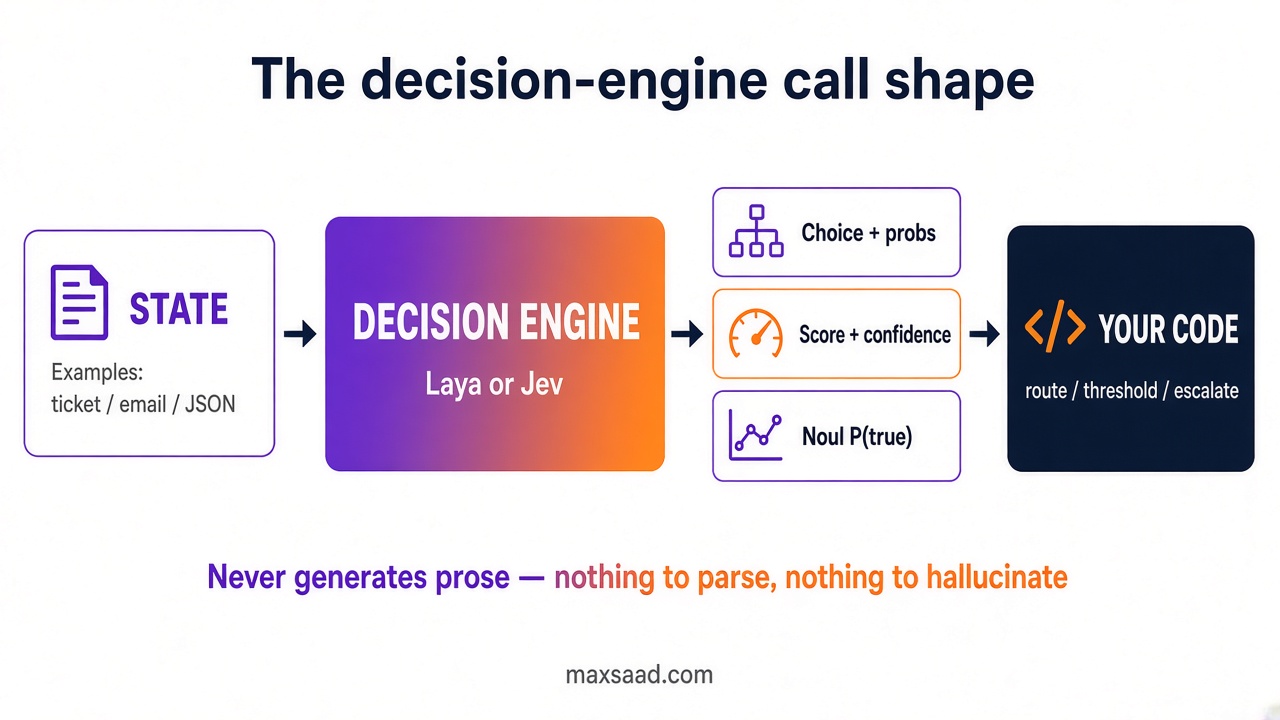
That shared shape matters more than the brand fight. Put either behind a thin interface so you can swap when the next checkpoint ships.
Head-to-head comparison
Numbers below mix project-published Laya figures, third-party published Jev latency, and independent write-ups (Flowtivity, Hugging Face model card). They were not all measured in one lab run — treat them as directional, then benchmark on your tickets.
| Laya (open) | Jev (managed) | |
|---|---|---|
| Who | Convai Innovations / Nandakishor Mukkunnoth | TypeSafe AI |
| Access | Apache 2.0 weights + pip install laya |
Hosted API (api.typesafe.ai) |
| Cost | $0 / token (you pay GPU/CPU) | ~$0.042 / MTok input; free output tokens |
| Latency (directional) | ~33 ms / question on T4 (routed multilingual); CPU warm can be hundreds of ms to tens of seconds on weak boxes | ~70–500 ms (TypeSafe); third-party p50 often cited ~236–276 ms |
| Languages | Router + multilingual checkpoint; ~45/51 languages usable (>3× random) on MASSIVE-style sweeps | No published multilingual benchmark I've seen |
| Zero-shot vs specialised | Base English ~0.36 on typed-decisions; fine-tuned specialist 0.766 | Published hard-label ~0.727 on that suite; zero-shot story is "managed and ready" |
| Wide option sets | Degrades past ~20 options at default token budgets (Banking77 ~0.425) | Stronger on high-cardinality choice (Banking77-class ~0.870 on published cuts) |
| Calibration | Advertised ECE after per-question temperature refit on your data; raw ships over-confident | Better out-of-box soft matching / raw calibration in some third-party reads |
| Context | English root 512 tokens; multilingual up to 1k default / 8k with max_len |
Managed API context (follow current docs) |
| Ops model | You own deploy, preload, fine-tune, audit trail | Waitlist/API key, TypeSafe runs the model |
Two honest sentences from the Laya card that should be on every slide:
"Laya is a fast base to specialise, not a zero-shot decision engine."
The 0.766 accuracy belongs to a checkpoint fine-tuned on that benchmark's training split — the base sits near chance / below majority class on the same suite.
How Laya is put together
Three checkpoints, one Router that picks before the forward pass (script/language detection in <1 ms — important because a confident English model on Khmer can score 0.000 accuracy at ~0.95 confidence):
| Checkpoint | Backbone | Params | Best at |
|---|---|---|---|
laya (English) |
ModernBERT-large | ~421M | English triage, guardrails, email |
laya-multilingual |
mmBERT-base | ~322M | 100+ languages; ~2.2× faster in published batch tables |
laya-typed-decisions |
ModernBERT-large | ~421M | Specialist workflows after fine-tune (~0.766 on that suite) |
Training story matches the System One pitch: RLCD — reinforcement learning against strictly proper scoring rules so honest probabilities maximise reward. Architecture is encoder + decision head (option markers at [MASK] tokens), not an autoregressive chat model.
Ops notes that matter in production:
Router(preload=True)avoids multi-second cold swaps when traffic flips languageslaya-servecan speak Jev's/v1/systemoneshape for client reuse- GPU (T4-class) for interactive paths; CPU-only VPS tests (Flowtivity) show warm predicts that are fine for batch, not for a hot request path on a thin box
The Doom lesson that actually transfers
Christian Graham's Medium piece taught Laya to play Doom — not as a gimmick, but as a stress test for messy, half-visible state.
What transferred to product work:
- Ask focused questions — "should I shoot?" beat dumping shoot into a giant choice list it always lost
- Bolt simple overrides for known failure modes (no ammo, spinning in corners) and log every override
- Calibration + policy beats vibes — the model proposes; your rules and confidence gates decide
That's the same staffing pattern I use with agents: decide cheap, gate hard, write rarely.
How I'd choose
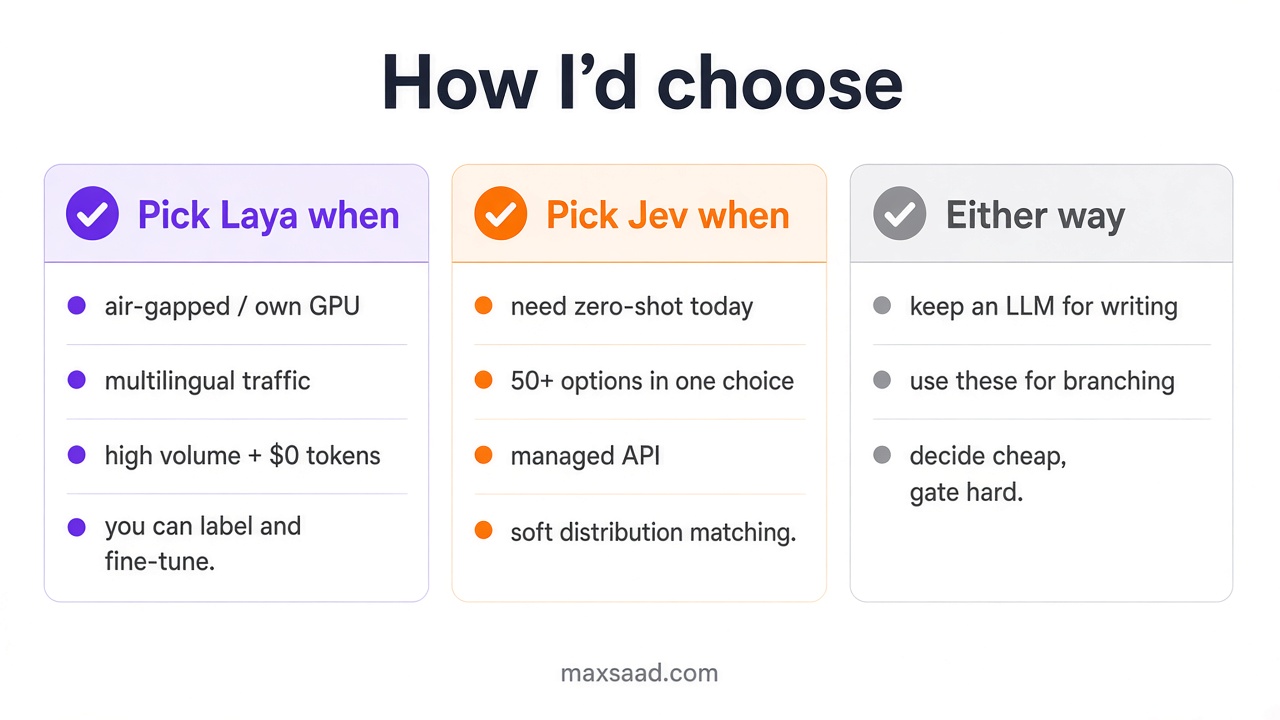
| If you need… | Start with… | Why |
|---|---|---|
| Air-gapped / customer data never leaves your VPC | Laya | Full weights, audit, on-prem |
| Multilingual traffic without per-token bills | Laya | Router + multilingual checkpoint |
| High-volume binary / few-option gates inside a request path | Laya (on GPU) | Sub-50ms directional latency when hot |
| You can label a few thousand examples + fine-tune | Laya | Where the accuracy jump actually lives |
| Zero setup and strong zero-shot today | Jev | Managed System One API |
| 50+ options in one Choice without tuning budgets | Jev | Published edge on high-cardinality sets |
| Soft distribution matching out of the box | Jev (often) | Soft-acc / raw calibration reads favour it in some reviews |
| Prose, explanations, multi-step reasoning | Neither — keep an LLM | Both are decision engines, not writers |
A useful cost sanity check from the field write-ups: at tens of thousands of decisions/month, Jev's metered bill is already small versus frontier chat routing. Laya zeroes the token line if a GPU is already next to your LLM stack — so the real decision is ops ownership vs managed convenience, not a CFO fire drill.
Five-minute Laya start
pip install laya
from laya import Router

router = Router(preload=True)  # keep checkpoints hot

state = "Hi, we were billed twice for March. Please refund the duplicate today or we will cancel."
questions = {
    "department": {
        "type": "choice",
        "instructions": "Which department should handle this?",
        "criteria": {
            "billing": "invoices, payments, refunds",
            "technical": "bugs, outages, system errors",
            "other": "everything else",
        },
    },
    "urgency": {
        "type": "score",
        "instructions": "How urgent is this?",
        "criteria": ["not urgent", "soon", "blocking"],
    },
    "churn_risk": {
        "type": "noul",
        "instructions": "Does the user threaten to cancel or leave?",
    },
}

result = router.predict(state, questions)
print(result["answers"]["department"]["choice"])
print(result["answers"]["churn_risk"]["noul"])
print(result["routing"]["model"])
Then, before any threshold hits production: label your own distribution, fine-tune (the project ships a free Kaggle notebook path), fit temperatures per question type, and log confidence vs outcomes weekly. Open weights don't remove that homework — they make it possible.
Bottom line for builders
Jev established the category: treat System 1 as a function call, not a chat window. Laya showed that category isn't locked behind a closed API — same Choice / Score / Noul shape, open weights, multilingual routing, and a fine-tune path you own.
Ship the decision layer behind a thin interface so either model is swappable. Benchmark on your own tickets before you trust a published table. Keep an LLM for prose. Promote Laya or Jev past read-and-route only after confidence thresholds and failure modes hold up on your traffic.
References
Related Resources
Enjoyed this? Let's work together.
I help companies turn AI strategy into shipped, revenue-generating products.