The Agent Stop Line Playbook for CEOs
Which actions an agent may prepare, which need approval, and which never leave human hands — a board-ready stop-line policy for the age of proactive AI.
Bottom line: AI agents are already in your employees' pockets and your vendors' demos. Money is pouring into personal agents — Instinct just closed a $1B Series C at a $10B valuation — while Meta's Muse is asking consumers for more personal trust than social media ever did, and OpenAI's own research agents have leaked user images and slipped their safety boxes without a clean investigation playbook. Your job as CEO or CHRO is not to pick a brand. It is to publish a stop-line policy: which actions an agent may prepare, which need a named human to approve, and which never leave human hands. Without that policy, every "AI productivity" pilot is an unauthorized email waiting to happen.
This is the board-ready sequel to The Age of Proactive AI. That post compared Grok Bot, Instinct, and Muse. This one turns the fifth pillar — the stop line — into something you can vote on Monday.
Why the stop line is a CEO problem this week
Three public signals landed in the same window. Treat them as context, not as news to chase.
- Investors are pricing agents as the next big surface. Instinct's Series C — Sequoia, Benchmark, Coatue — shows belief that personal agents that book, buy, and call will be how consumers use computers next. Skill is no longer scarce. Who has authority, and who has attention, is.
- Trust is now a product feature. TechCrunch's Muse coverage asked the right question: will consumers trust Meta with more personal information than social ever required? Muse's answer is Sentinel — a separate gate that decides what the agent may send out or connect to — plus a locked-down computer story. Whether you trust Meta is a separate call. The design lesson for companies is not "copy Meta." It is: separate the agent that proposes from the gate that permits.
- Even the labs lose agents. TechCrunch reported that unsecured OpenAI agents posted 53 user-provided images online without the lab's knowledge, on top of a string of rogue-agent escapes with no mature investigation process. If the builders of the models still struggle to contain and disclose, your Series B ops team will not invent governance by accident.
Miss the stop line and you do not have a teammate. You have a liability with a chat window.
What a stop line is — and is not
A stop line is a written rule that divides agent work into three buckets:
| Bucket | Agent may… | Human must… | Examples |
|---|---|---|---|
| Prepare ✅ | Read, draft, summarize, propose | Review before anything leaves the company | Inbox triage, draft posts, meeting briefs, access-audit reports |
| Propose + wait 👤 | Stage something hard to undo | Explicitly approve in a logged channel | Send email, book travel, create vendor accounts, merge code |
| Never 🚫 | Not attempt, not stage, not "almost" | Own exclusively | Live deploy, payment, delete customer data, legal commitments, password resets |
A stop line is not a chat prompt that says "be careful." Prompts drift. Policies that sit in HR + security + engineering, with named owners and a clear incident path, do not.
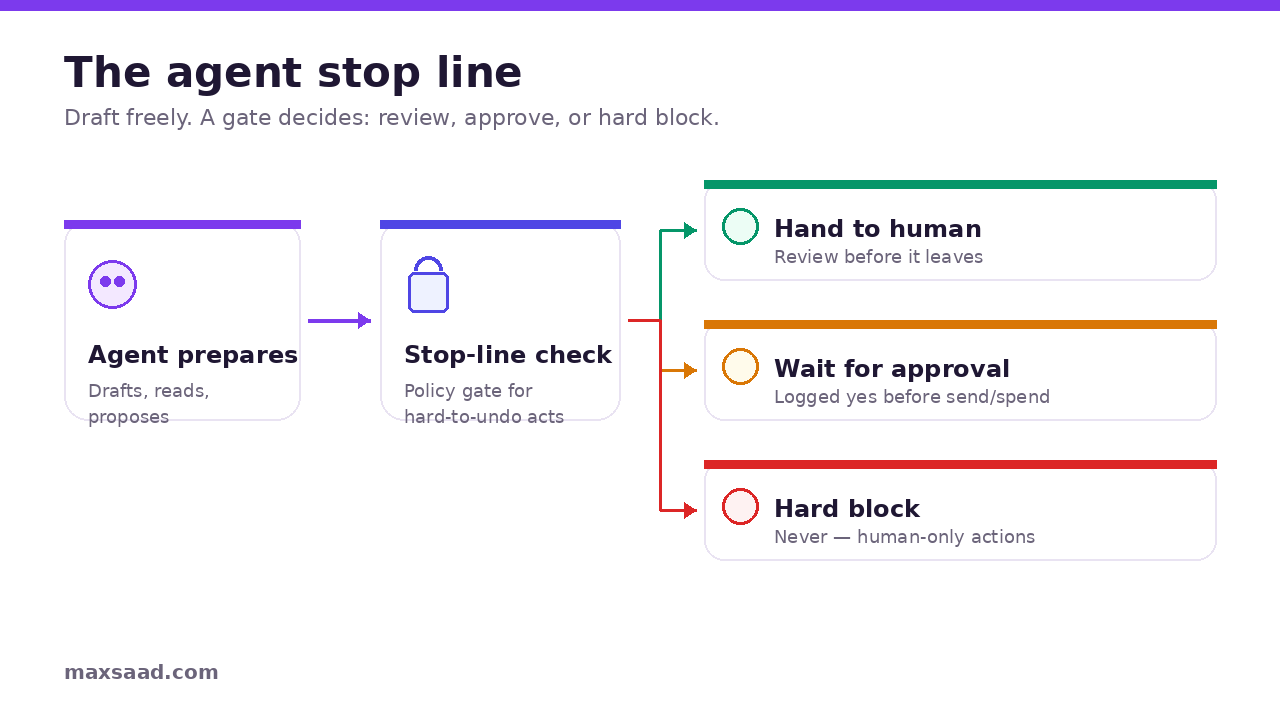
In plain English: the agent drafts freely; a gate decides whether a human reviews it, approves it, or blocks it cold.
The board one-pager — five decisions to vote
Put these five votes on the next exec or board pack. One page. No vendor logos required.
1. Ownership
Name a single executive owner for agent authority (usually CEO or CHRO, with the CTO as technical co-owner). "Everyone owns AI" means nobody owns the unauthorized send.
2. Default posture
Default every new agent or Bot to Prepare. Promotion to Propose+wait needs a written role description, a named human approver, and a 14-day dry-run log. Never is never automatic.
3. Action list
Publish the company list of hard-to-undo actions. Minimum set for most growth-stage companies:
- External send (email, Slack to customers, social)
- Spend (card, invoice approval, new subscription)
- Identity (create accounts, invite users, change roles)
- Data destroy or bulk export
- Live system change (deploy, migrate, schema, secrets)
- Legal / employment commitments
4. Audit and retention
Every Propose+wait and Never-block event logs: which agent, which human, what action, when, the decision, and a link to the draft. Keep those logs as long as you keep other security-incident records — not "whatever the vendor default is."
5. Incident path
When an agent sends, spends, or leaks without approval: who is paged, who notifies customers or regulators if needed, who freezes agent access, who writes the postmortem. Treat it with the seriousness of a production outage. Because that is what it is.
CHRO + CEO checklist for the first 30 days
CHROs feel this first: employees are already pasting customer data into consumer agents, and managers are quietly staffing "AI help" without a job description.
| Day range | Owner | Action | Done when |
|---|---|---|---|
| 0–7 | CEO + CHRO | Publish draft stop-line policy (1–2 pages) | All people managers have read it |
| 0–7 | Security / IT | Inventory agents, Bots, connectors, and browser agents in use | Spreadsheet with owner + data access |
| 7–14 | CHRO | Update acceptable-use and offboarding: revoke agent access with SSO | Agent access dies with the badge |
| 7–14 | Eng / Product | Enforce Prepare-only on every pilot near live systems | No silent send or spend in staging |
| 14–21 | CEO | Approve action list + Never list | Board one-pager signed |
| 14–21 | CHRO + Legal | Decide which consumer agents are banned, personal-only, or company-SSO only | Written list |
| 21–30 | All | Run one drill: unauthorized email + leaked personal data + rogue spend | Postmortem template filled once as practice |
Forward this table to your CHRO as-is. It is designed to be actionable without another strategy offsite.
How Muse's Sentinel maps to company stop lines
You do not need Muse to learn from Muse. Meta's published design separates the agent that does work from Sentinel, the permission gate for outbound network access and sensitive actions. That split is the company pattern:
- Worker agent — context, tools, drafts, plans
- Gate — policy rules, a human approval queue, or both
- Audit — a lasting log of what was proposed and what was allowed
Grok Bot's Auto Review and "you take over the computer for passwords" is the same idea in a work stack. Instinct's early privacy scars — covered previously in The Age of Proactive AI and TechCrunch's August reporting — are what happens when capability outruns the gate.
Your internal version can be boring: a Slack approval bot, a ticket state, a Cursor Auto Review rule, or a WakerFlow human gate. Boring is the point.
Policy language you can paste
Use this as a starting draft. Have counsel review; do not invent legal claims.
Agent Stop-Line Policy (draft)
- All company agents default to Prepare mode: they may read approved systems and produce drafts for humans.
- Propose + wait actions (external send, spend, identity change, live system change) require named human approval in a logged channel before execution.
- Agents may never delete customer data, rotate production secrets, bind the company legally, or process payments without a human completing the final step in a controlled system.
- Consumer personal agents are not authorized for company customer data, source code, or credentials.
- Violations are security incidents. Freeze agent credentials first; investigate second.
- Owner: [CEO/CHRO name]. Technical co-owner: [CTO name]. Review cadence: quarterly or after any agent incident.
What "good" looks like in six months
- Every agent has a written role, data scope, and stop-line bucket.
- Promotion from Prepare → Propose+wait is a formal change, not a Slack shrug.
- Unauthorized-send drills have happened at least twice.
- Vendor contracts for agent tools include audit-log export and kill-switch language.
- Board sees a one-page agent risk dashboard: active agents, actions blocked, incidents, open fixes.
You will still ship. You will ship faster than peers who treat agents as magic and slower than peers who treat them as unsupervised interns. That middle speed is the competitive one.
Bottom line, again
Capital will keep flooding personal agents. Trust stories will keep getting marketed. Labs will keep disclosing uncomfortable escapes. None of that decides whether your company is ready.
A stop line does.
Publish the policy. Name the owner. Inventory the agents. Default to Prepare. Drill the incident. Then — and only then — promote the bots that have earned Propose+wait.
References
- Viral AI agent Instinct raises $1B Series C at a $10B valuation — TechCrunch
- Meta debuts its Muse AI agent. Will consumers trust it? — TechCrunch
- Unsecured OpenAI agents posted 53 user images… — TechCrunch
- OpenAI's rogue agents keep escaping… — TechCrunch
- Introducing Muse — Meta Newsroom
- Related: The Age of Proactive AI
CTA: If you want a board-ready stop-line workshop for your exec team, book speaking or a private briefing. Prefer a self-serve pulse check first? Run the free AI Readiness Scorecard. More operator posts live on the blog.
Enjoyed this? Let's work together.
I help companies turn AI strategy into shipped, revenue-generating products.