
Private AI fits on a desk now. Here's how I'd start.
Private AI now fits on a desk. Models are becoming commodities, your data is the moat, and the way to start is one box, one workflow, one month.
On Saturday, 17 October, I sat in a packed hall at ACE Malaysia 2026, the NVIDIA x GIGABYTE event on agentic computing at the edge. I went in expecting the usual hardware keynote. I came out with one idea stuck in my head:
Private AI is practical now.
Practical for ordinary companies, well beyond the ones with a data center and a platform team. A petaflop-class box sits on a desk, plugs into a wall socket, and runs a capable model that finishes real agent work while your data stays in the building.
For CEOs and CHROs, that changes the conversation. Here's why, and what I'd actually do about it.
The slide that made the case
The talk that stuck with me was Hariharan Suresh from NVIDIA on accelerating local AI agent development, a walk through the GB10 chip and NemoClaw.
One chart did most of the work. It plotted models on a single DGX Spark: intelligence on one axis (the local.ai Intelligence Index), and on the other, how long each model took to finish a real agent task end to end.
Nemotron 3.5 Super sat right on the frontier: a score of 80, and 6.5 minutes per task. A couple of models scored a bit higher but took longer. The small, fast models finished in under a minute but scored far lower, some below 30.
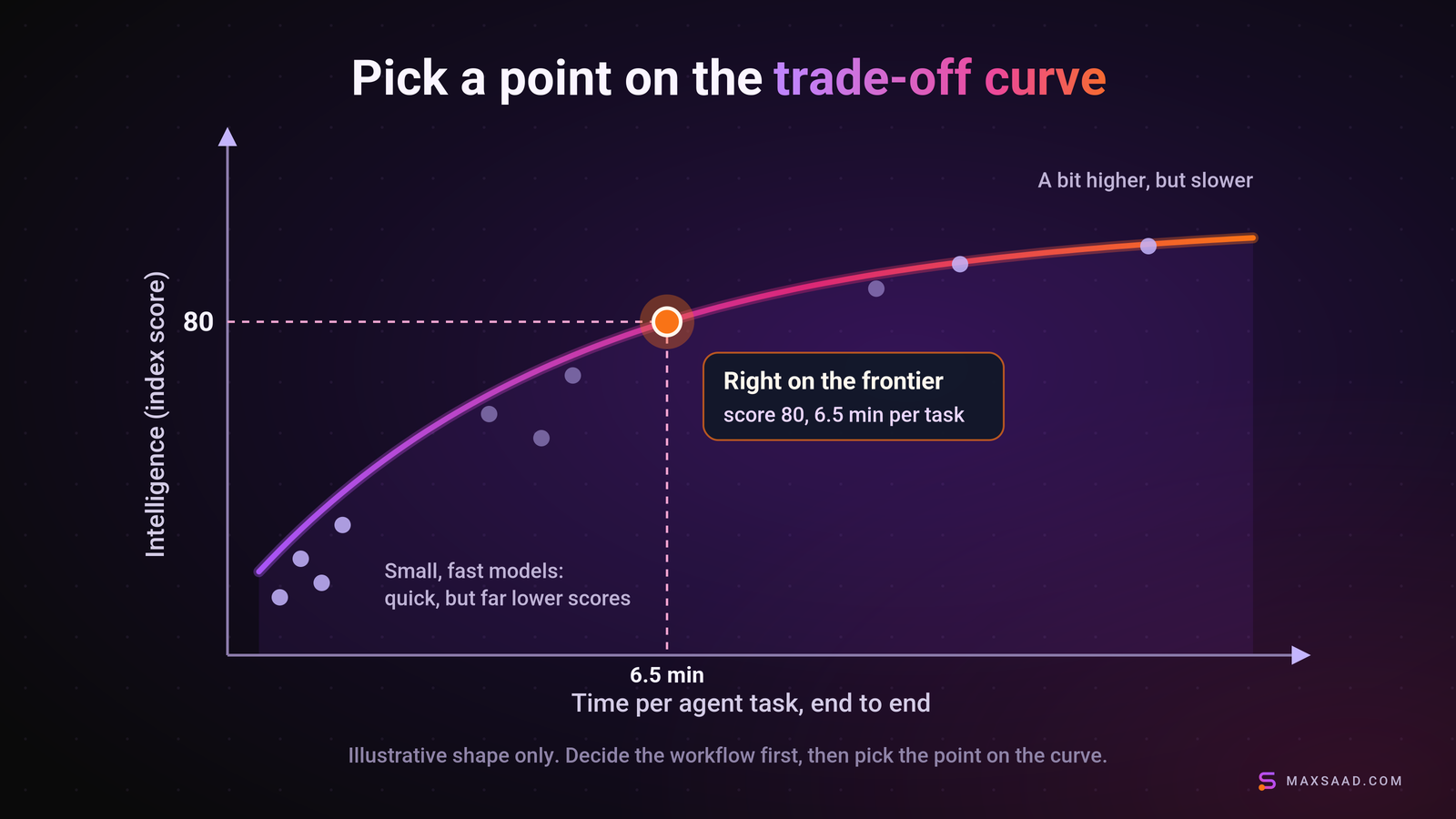
That's the shape you want to see: a clear trade-off curve you can pick a point on, instead of one magic model. Want speed for a simple triage loop? Go small. Want a model that can reason through a multi-step task while you get a coffee? There's a good option, and it runs on one box.
I'll be honest about the limits of one slide at a vendor event. It's NVIDIA's chart about NVIDIA's hardware. Benchmarks measure someone else's workflow. Still, the direction matches everything else I've watched this month.
Models are becoming commodities
Earlier that week I was looking at the Gemini 4 Argon launch. Google said it beat GPT-6 Astra and Claude Opus 5.5. The independent scores told a quieter story: Argon 53, Astra 53, Opus 5.5 58.
The interesting part sat off the leaderboard. Argon launched at roughly a fifth of the price of its rivals and hallucinated 15% of the time against 51% for Astra.
Put that next to the DGX Spark chart and the pattern is obvious. The gap between "best model" and "good enough model" keeps shrinking, and the price of good enough keeps falling, in the cloud and on your desk.
When the model is a commodity, the advantage moves somewhere else.
To your data.
Your customer history, your internal docs, your process knowledge, the messy spreadsheets that actually run the business. That's the part a competitor can't download. And for a lot of companies, it's exactly the part legal, compliance or the board want kept away from someone else's API.
So keep it at home.
Agents that act
The other thing this week reminded me of: the value lives in the agent doing the work. The chat window is just the front door.
A few days later I wrote a thread about people using AI to make their smart TVs dumb again. Ryan Doyle sent Claude Code his TV's listing and asked, "can you hack this?" Hours later Gathin did his parents' Xiaomi TV: 25 packages switched off, a lighter home screen installed, one afternoon. His repo, cleanyourtv, has nearly 7,000 GitHub stars.
How it works is the point. You turn on developer mode and point an agent at the TV over Wi-Fi. It disables the TV's own ads, the telemetry and the preloaded apps. One script undoes it. (It only works on Android and Google TV sets, and YouTube ads stay put.)
Nobody chatted with that TV. The agent took a goal, worked against a real device on a local network, and changed something. It carries some risk, too: one person says they bricked theirs, and you should turn debugging off when you're done.
That's the mental model I want leaders to bring to private AI. A private ChatGPT clone gets forgotten by week two. Buy the box to run an agent that does a job.
How I'd start: one box, one workflow, one month
Here's the advice I gave in my thread, expanded a little. Start embarrassingly small.
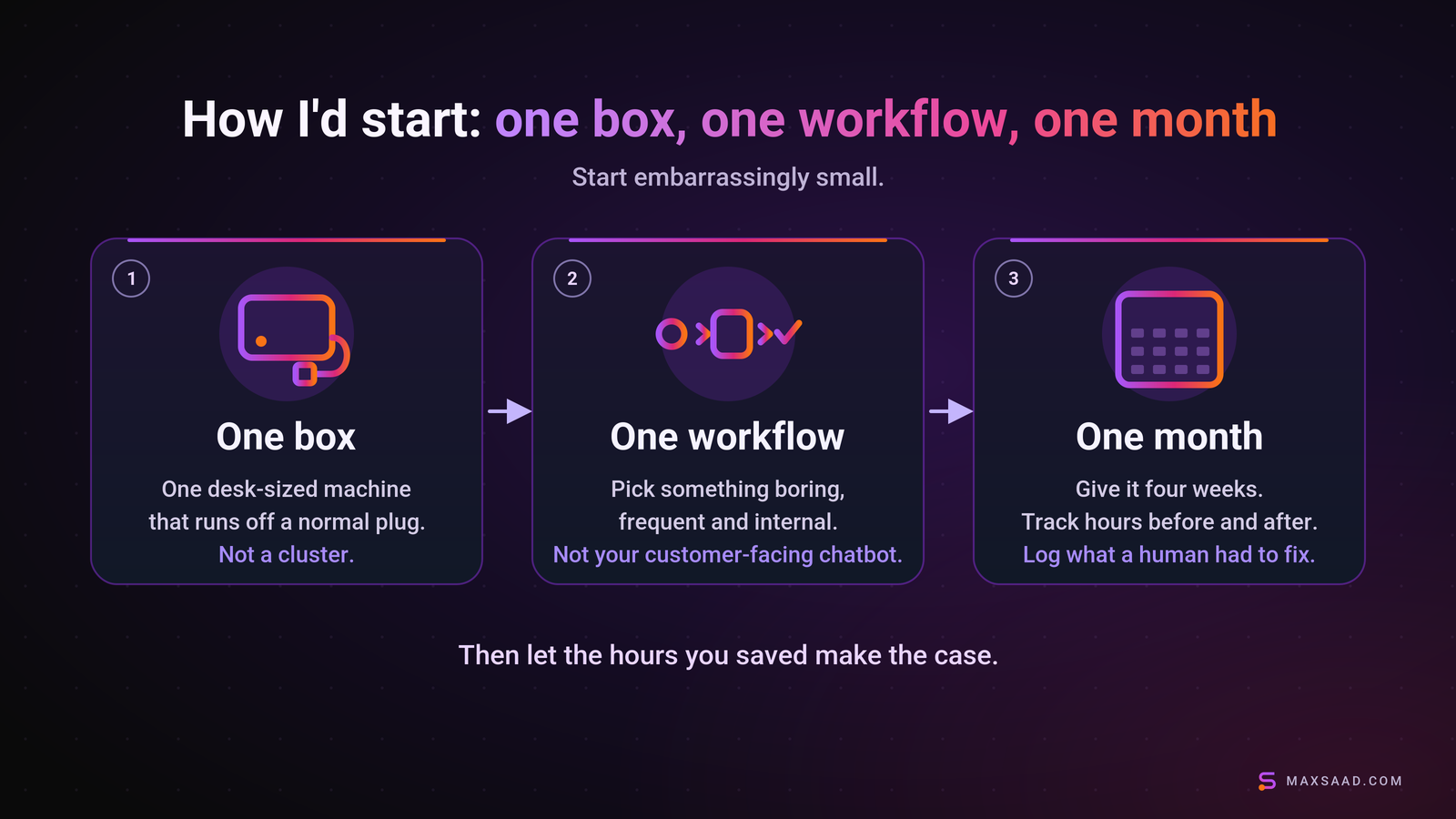
One box. Skip the cluster and the procurement cycle. One desk-sized machine that runs off a normal plug. The whole point of this hardware generation is that the first experiment skips the infrastructure project entirely.
One workflow. Pick something boring, frequent and internal. The best candidates have three things in common:
- The data is sensitive enough that you'd hesitate to send it to a public API.
- A person does it every week, by hand, and would happily stop.
- You can tell quickly whether the output is right.
Think: reconciling exports between two internal systems, drafting first-pass summaries of internal documents for a team that reads them anyway, or triaging an inbox of requests into the right queue. Save the customer-facing chatbot and the "AI strategy" for later.
One month. Give it four weeks. Track hours before and after. Log what the agent got wrong and what a human had to fix.
Then let the hours you saved make the case. A board deck full of AI ambition is easy to ignore. "Finance got back a day a week and the data never left the office" gets the room's attention.
What to watch out for
I've spent 13+ years building and running technology, including time as a CIO, so here are the traps I'd expect.
Picking the model before the job. The chart above is useful only once you know whether your task needs a 30-second answer or a 6-minute reasoning run. Decide the workflow first, then pick the point on the curve.
Treating "local" as "safe." Keeping data on-premises solves one problem: where the data goes. What the agent is allowed to do is a second problem, and it's still yours to solve. An agent that can act on your systems needs the same thinking you'd give a new hire's access: what can it read, what can it change, and who checks its work. The smart TV story is a cheerful version of this. The workplace version is less cheerful when it goes wrong.
Letting it become a science project. If after a month the hours saved are still a guess, stop, pick a different workflow, and run the month again. A wasted month is still far cheaper than a pilot that drifts for a year.
Ignoring the people part. The team whose work you're automating should help pick the workflow. They know where the time actually goes, and they'll be the ones deciding whether to trust the output.
Why this matters for Malaysia
The other thing I noticed in that hall: it was full, on a Saturday. Kuala Lumpur can start serious AI work now, instead of waiting for a hyperscaler region or a giant budget. A capable box on a desk levels that a lot.
For regional companies with real data-residency questions, that matters even more. "We can't send that data overseas" has been the end of many AI conversations here. Now it can be the start of one.
The short version
- Private AI is practical now. A desk-sized box can run a model that finishes real agent tasks in minutes.
- Models are becoming commodities. Your data is the moat, so keep it at home.
- Put the agent to work on a real job. Chat is the easy part.
- Start embarrassingly small: one box, one workflow, one month. Let the hours saved make the case.
If you're in KL and building on local models, I want to hear what you're running and what broke. And if you're a CEO or CHRO trying to work out which workflow to try first, that's exactly the conversation I want to have.
Enjoyed this? Let's work together.
I help companies turn AI strategy into shipped, revenue-generating products.