
GitHub Universe 2026: what changes when AI agents write half your code
GitHub Universe 2026 turned Copilot into a delivery system that reviews, approves and bills by usage. What CEOs and CHROs should decide about review, permission and cost.
Bottom line: At GitHub Universe this week, Copilot stopped being a coding assistant and became a delivery system. Agents can now take a goal across several repositories, fix their own failing builds, review each other's work, and give an approval that counts toward your merge rules. For a CEO or CHRO, that moves three decisions onto your desk: who reviews, who grants permission, and who watches the bill.
I followed the announcements from Kuala Lumpur, through GitHub's keynote post and the 30-plus changelog entries tagged for the event. Here's what matters for leaders, and what I'd do about it on Monday.
What GitHub announced, in plain terms
Jay Parikh, who runs CoreAI at Microsoft (GitHub sits in his organisation), framed it in one line in the keynote post: "Completed work, not more code, is the output that matters." Developers set direction and stay accountable. Agents implement and verify.
The launches that back that up:
- Copilot projects (public preview). You give Copilot a goal and the context, and it runs as many agents as the work needs across multiple repositories, then brings back pull requests for review.
- Copilot Fusion. It routes each task to one or more models based on what the task needs. GitHub says Fusion Max scored within two points of Opus 5.5 Max on the Artificial Analysis Coding Agent Index at half the cost.
- Copilot automations got new triggers, 20 new tools, custom MCP connections, and per-run, daily, weekly and monthly AI credit limits. They can now propose improvements to their own prompts based on outcomes, and you approve each change.
- Agent Merge watches a pull request and fixes failing workflows and merge conflicts in the cloud. Combined with auto-merge, GitHub merges as soon as requirements are met.
- Copilot code review Max runs several review agents on models from different providers, then reconciles their findings. Copilot approvals are now generally available, and a Copilot approval counts toward your required approvals.
- Copilot inside GitHub Enterprise. Enterprise customers working with a GitHub or Microsoft account team can now get Copilot for every licensed user, billed by AI credits used rather than by seat.
Each of these is useful on its own. Read together, they describe a pipeline where an agent can plan, write, fix, review and approve. The human jobs that remain are the ones that decide whether that pipeline is safe to run.
Review is the new constraint
GitHub said it directly: more code means more pull requests and more demand for review. Their answer is more review agents, and I think that's the right instinct. A panel of models from different providers catching different blind spots is a sensible design, and GitHub reports Max posted the highest F1 score on ReviewBench for high-severity issues.
Here's the leadership question, though. Copilot approvals are off by default. Admins turn them on per enterprise, organisation or repository, and can limit which file paths Copilot may approve. Someone in your company will make that call. It should be a deliberate decision with an owner, made before a team flips it on because the queue got long.
My view: let agents approve low-risk paths (docs, tests, internal tooling) early. Keep a named human on authentication, payments, data access and anything that touches customers. Pay for the deepest review on exactly those paths, since GitHub's own guidance is to pair Max with approvals where a missed issue costs the most.
Then measure the thing that actually limits you: time from pull request opened to merged, and how much of that time is waiting on a person. If review is your bottleneck, more coding agents only make the queue longer.
Permission is the product
Two weeks ago I wrote that the agent bottleneck is permission. Universe put that idea into the settings page.
Look at how many of this week's launches are really permission controls:
- Approvals have path-level scopes and an off switch at three levels.
- Automations define exactly which tools an agent may use, and a new "Can be triggered by" setting decides whether events from other automations, such as a pull request opened by Copilot, can fire the next one. It defaults to users only.
- Automations can now merge pull requests, if you allow that tool.
- Computer use in the Copilot app asks for approval before taking control of a desktop app, and organisations can switch it off.
- Just before the event, GitHub made Copilot assisted permissions generally available and opened enterprise installations for GitHub Apps, which replace classic personal access tokens.
Chain those together and you can build a loop where one agent opens a pull request, another reviews and approves it, Agent Merge fixes the build, and auto-merge ships it. Every link is a setting. That's powerful, and it's exactly why someone senior needs to write down which links are allowed to connect.
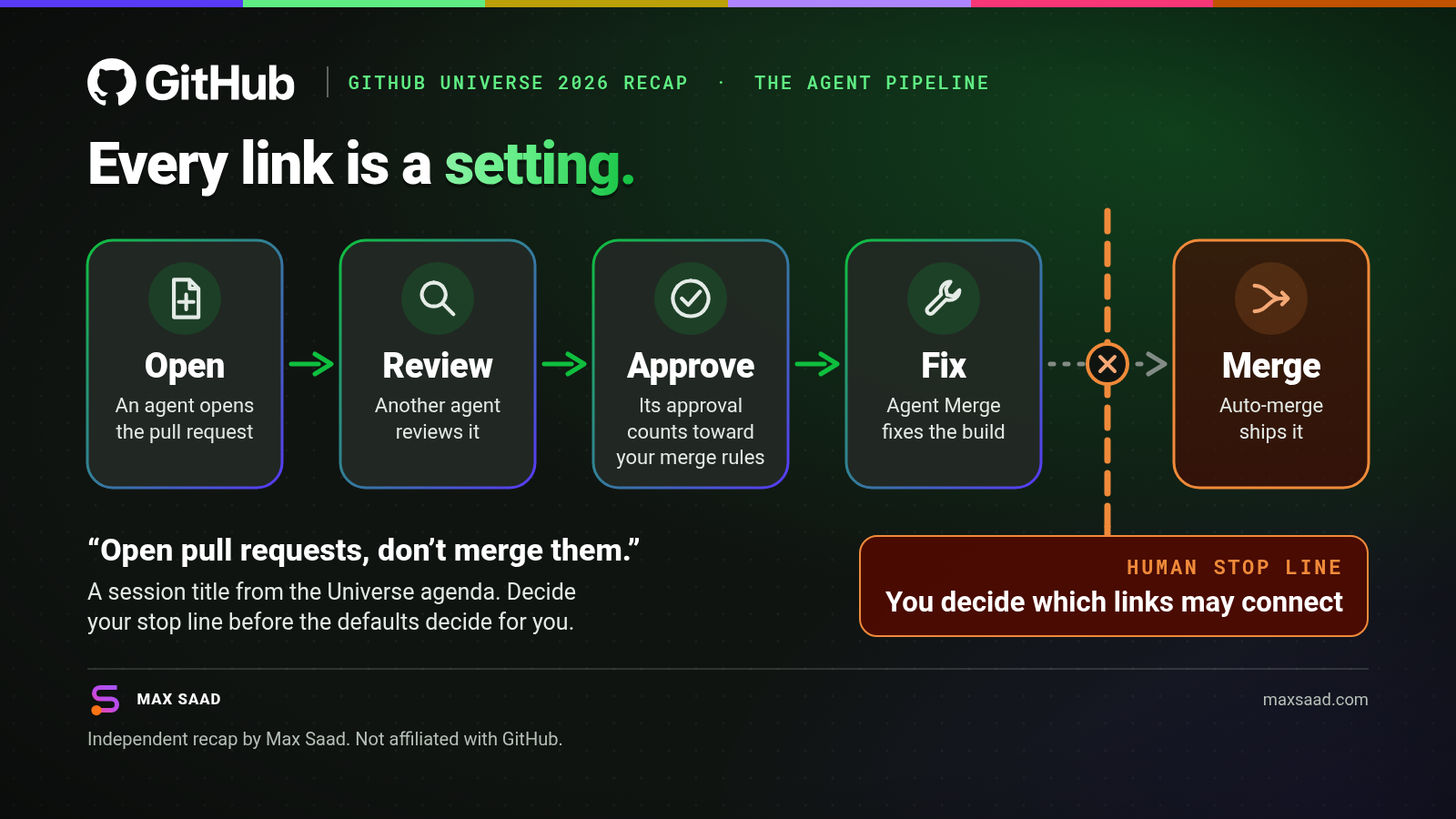
One session title from the Universe agenda says it best: "Open pull requests, don't merge them." That's a stop line. Decide yours before the defaults decide for you.
Cost moves from seats to usage
The pricing change is the quiet headline. With Copilot included in GitHub Enterprise, GitHub says usage against your enterprise budget becomes "the primary thing to manage." Usage is metered from the first request. Completions keep working with no budget left; chat, code review and cloud agents need budget to run.
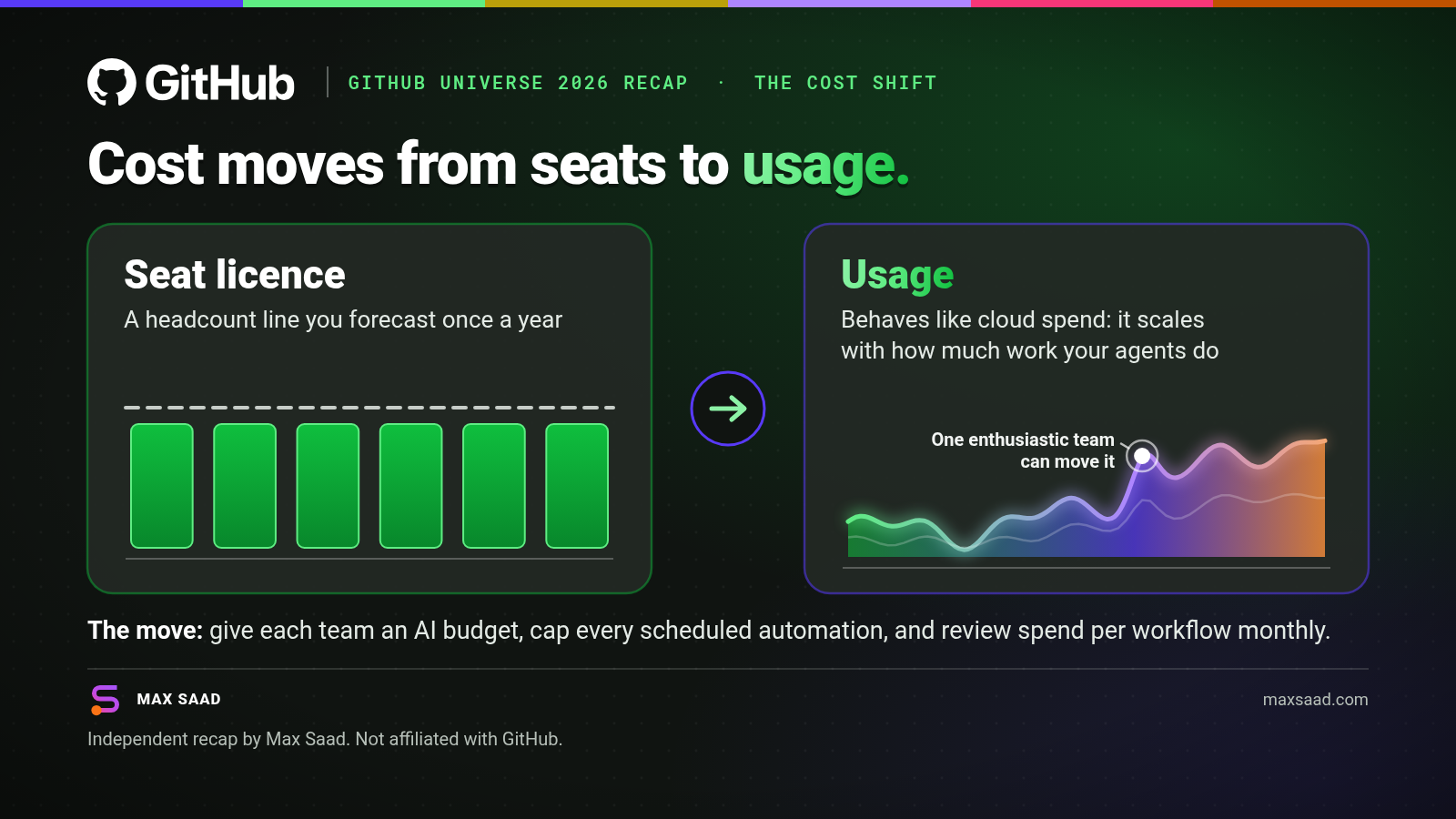
That's a shift every CFO and CIO will feel. A seat licence is a headcount line you forecast once a year. Usage behaves like cloud spend: it scales with how much work your agents do, and a single enthusiastic team can move it.
GitHub gave you the levers. Fusion picks cheaper models where they're good enough. Automations take hard credit limits per run and per period. Code review offers Lite, Balanced and Max, and admins can cap the maximum level. The usage metrics API, updated this month, now names the custom agents, skills and MCP servers people use.
The move: give each team an AI budget, set caps on every scheduled automation, and review spend per workflow monthly, the same way you review cloud spend. Spend that maps to completed work is a good sign. Spend you can't explain is a sign an automation is looping.
The CHRO angle: the job is directing and checking
Parikh's framing, that developers set direction, make decisions and stay accountable while agents implement, is a job description. It changes who you hire and what you train.
The skills that grow in value:
- Writing a clear goal. Copilot projects start from a goal plus context. Vague goals produce plausible work in the wrong direction.
- Review judgement. Knowing which changes are risky, and reading an agent's pull request with healthy suspicion.
- Curating context. GitHub's own pre-event write-up on Copilot memory research noted that accumulated context can hurt performance, and called for treating AI context as infrastructure. Someone has to own that.
- Running the improvement loop. Self-improving automations propose prompt changes for a human to accept or reject. That's a new, real responsibility.
For engineering career ladders, I'd add "quality of delegation" and "quality of review" as explicit criteria next to delivery. Your strongest engineers are about to manage a team that never sleeps. Reward them for managing it well.
What I'd do on Monday
- Write the agent permission policy. One page: which paths agents may approve, which tools automations may use, whether automations may trigger each other, and where a human must sign.
- Name review owners for your high-risk paths, and start measuring time waiting on review.
- Put a budget and caps on usage. Credit limits on every scheduled automation, a monthly spend review per team.
- Set a default model and review-effort policy, so the expensive settings are a choice for risky work.
- Run one delegated workflow end to end, such as issue triage or dependency updates, with a clear stop line, and learn from it before you scale.
GitHub has built the machinery for agents to ship software on their own. The companies that do well with it will be the ones whose leaders decided, in writing, how far that machinery may go.
Written from Kuala Lumpur. Sources: GitHub's Universe keynote post and changelog, October 2026.
References
- GitHub Universe 2026: Evolving every layer of the stack — The GitHub Blog
- Universe 2026 changelog entries — GitHub Changelog
- Copilot code review: Merge with confidence with Max and approvals — GitHub Changelog
- Agent Merge watches and fixes pull requests in the cloud — GitHub Changelog
- New tools, triggers, and cost controls for Copilot Automations — GitHub Changelog
- Copilot Automations now learn from outcomes and self-improve — GitHub Changelog
- GitHub Enterprise now includes access to GitHub Copilot — GitHub Changelog
- GitHub Copilot app, Universe releases — GitHub Changelog
- October 2026 — GitHub Changelog
- 10 technical talks I’m excited about at GitHub Universe 2026 — The GitHub Blog
- Related: The Agent Bottleneck Isn't the Model. It's Permission.
Enjoyed this? Let's work together.
I help companies turn AI strategy into shipped, revenue-generating products.