Claude Opus 5.5: Frontier Coding at 40% Less Cost
Anthropic's Opus 5.5 hits frontier coding with ~40% lower typical workload cost and 30%+ faster output — why that matters for agentic teams.
I rarely get excited about a model drop for the price sheet. Claude Opus 5.5 is the exception.
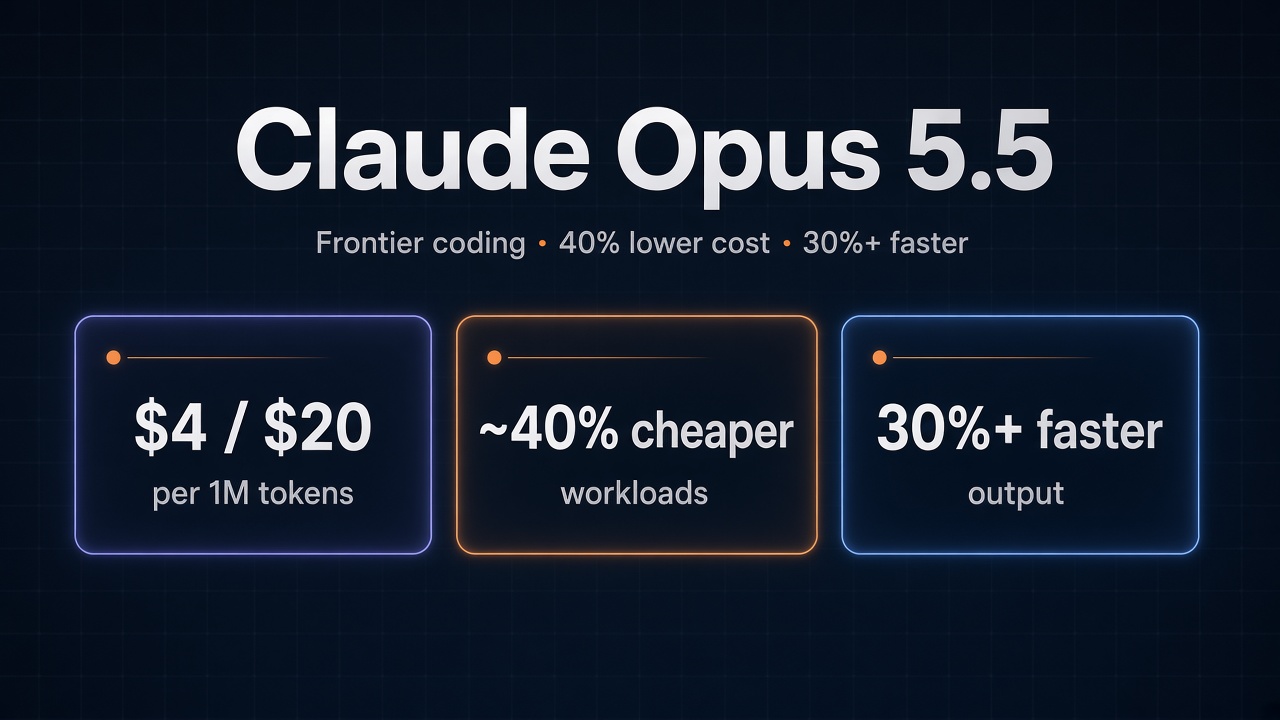
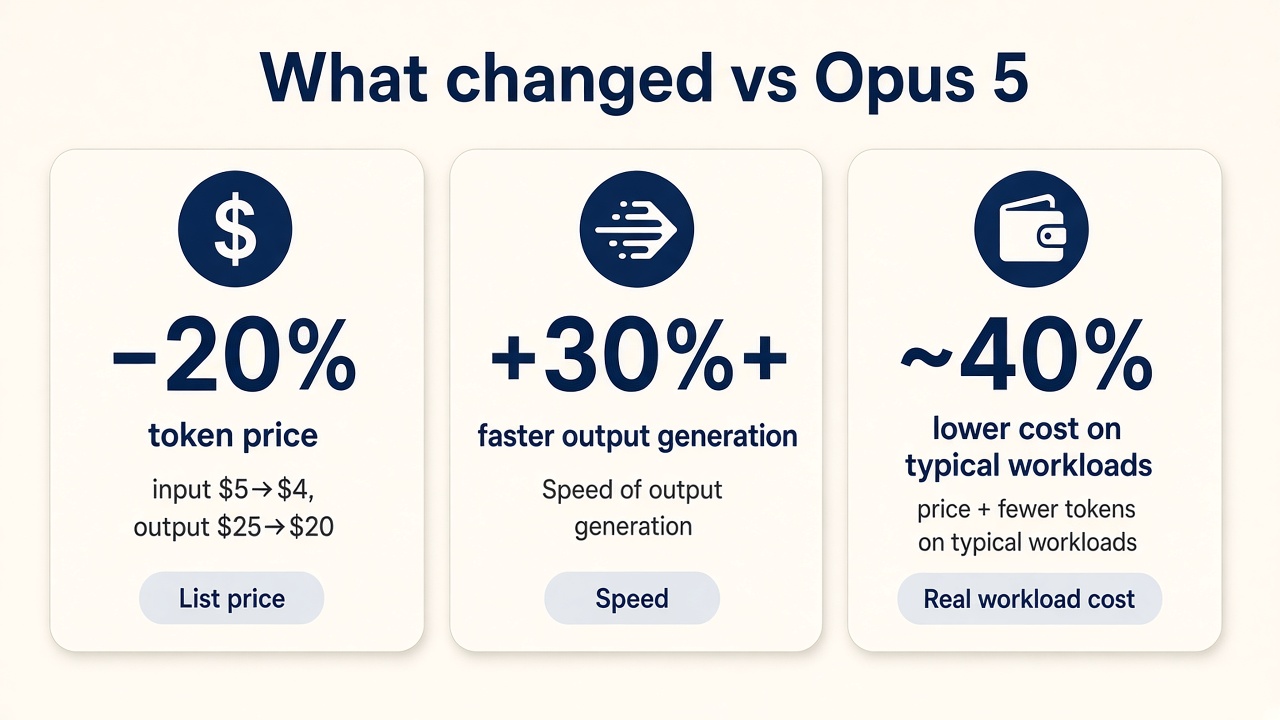
Anthropic shipped the first model in the Claude 5.5 family on September 22, 2026 — and the headline that matters for anyone running agents (or paying the bill) is blunt: frontier-level coding performance, ~40% lower cost on typical workloads, and output generation more than 30% faster than Opus 5. List price is $4 / $20 per million input / output tokens. Cache reads — the quiet majority of agentic spend — dropped to $0.20 per million.
That's not a vanity benchmark flex. That's more overnight migrations, more review loops, and more "leave it running" sessions before the CFO notices.
Why this one hits different
Most frontier releases force a trade: smarter or cheaper or faster. Opus 5.5 is Anthropic arguing you can take all three at once — at least relative to Opus 5.
| Opus 5.5 | Opus 5 | Delta | |
|---|---|---|---|
| Input / 1M tokens | $4 | $5 | −20% |
| Output / 1M tokens | $20 | $25 | −20% |
| Cache reads / 1M | $0.20 | $0.50 | −60% |
| Cache writes / 1M | $5 | $6.25 | −20% |
| Output speed | >30% faster | baseline | — |
| Typical workload cost | ~40% less | baseline | price + fewer tokens |
Model ID for builders: claude-opus-5-5. 1M context, 128K max output. Available across Claude, Claude Code, the API, AWS, Google Cloud, and Azure. Fast mode (up to ~2.5× speed) is available at $8 / $40 if you need the latency more than the discount.
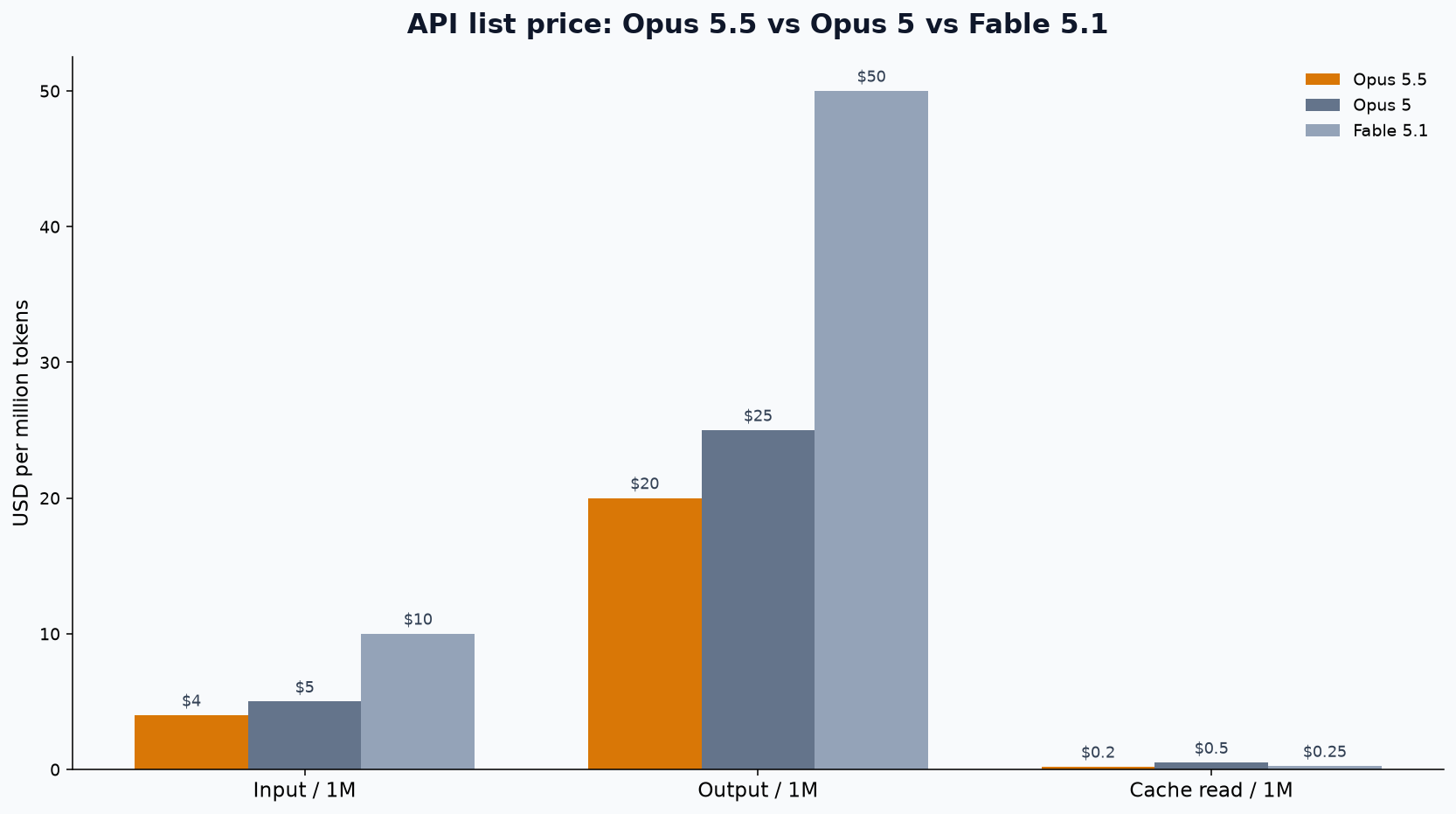
Versus Anthropic's own higher tier: Fable 5.1 still sits at $10 / $50. Opus 5.5 undercuts that unit price hard while leading several of the coding and knowledge-work benches Anthropic published.
The coding numbers that matter
Benchmarks are noisy at this level — Anthropic says so themselves. Still, the directional story is hard to ignore for anyone whose agents live in a terminal.
| Benchmark | Opus 5.5 | Fable 5.1 | Opus 5 | GPT-6 Astra |
|---|---|---|---|---|
| Terminal-Bench 4.0 | 66.4% | 55.8% | 52.3% | 57.9% |
| FrontierCode v1.1 (Main) | 54.4% | 50.3% | 48.0% | 53.3% |
| CursorBench 4.0 | 57.8% | 51.8% | 46.6% | — |
| GDPval-AA v2.1 (Elo) | 1846 | 1735 | 1708 | 1542 |
| OSWorld 2.0 (partial) | 81.8% | 80.7% | 74.0% | — |
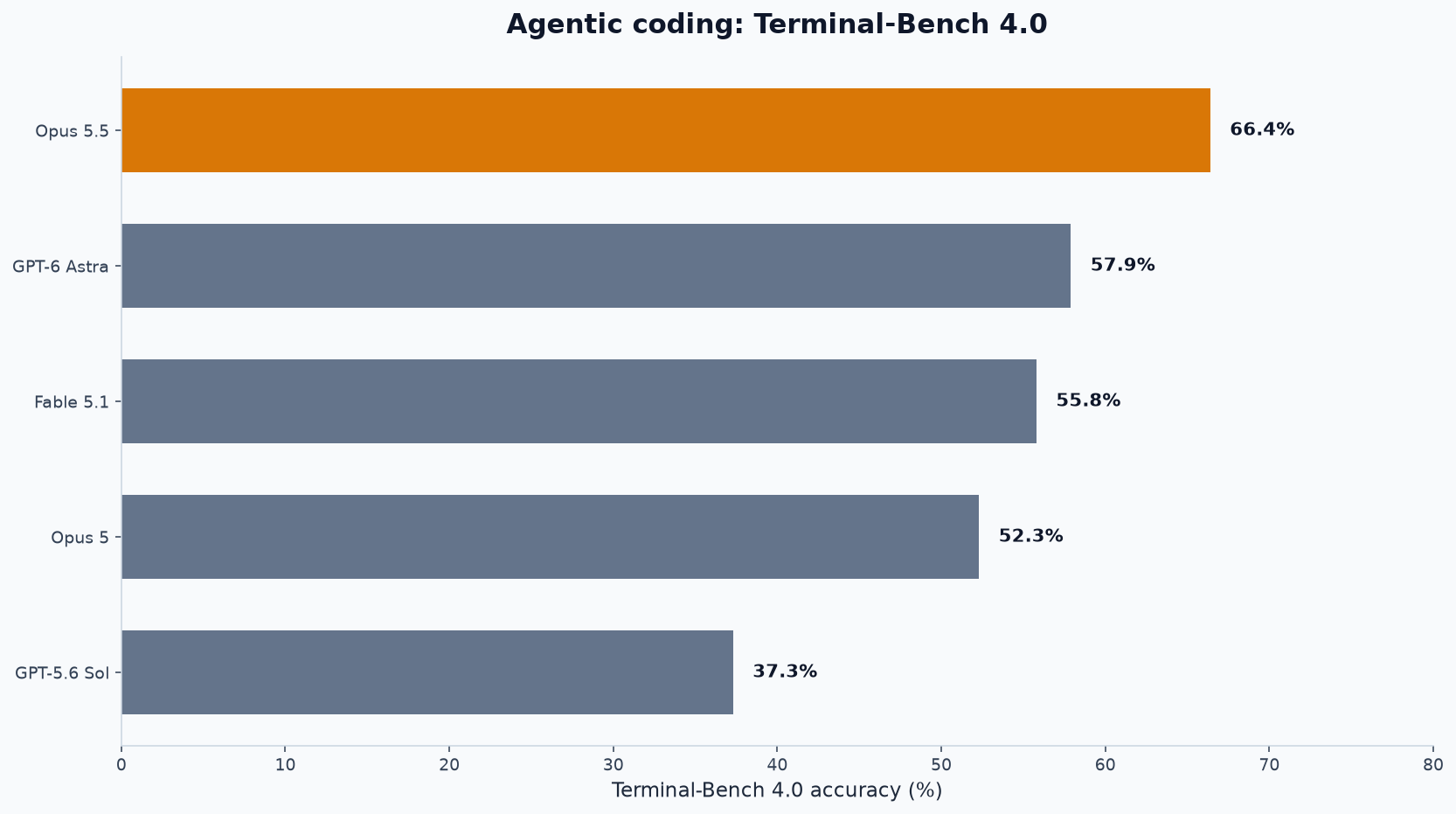
Anthropic's efficiency claim is the part I'm watching closest: on Terminal-Bench, Opus 5.5 at default effort beats Opus 5 at max effort for about a fifth of the cost. On FrontierCode, it beats GPT-6 Astra at roughly a fifth of the cost per task. Early testers (GitHub, Lovable, Stripe-adjacent engineering write-ups in the announce) keep saying the same thing in different words: fewer steps, fewer tokens, less rework.
Early tester stories that stuck with me:
- A 200,000-line codebase audit took Opus 5 over 20 hours and about 2.5× the tokens. Opus 5.5 finished the same job in under three hours.
- On an internal HAProxy C→Rust rewrite, both Opus 5.5 and Fable 5.1 passed nearly all of HAProxy's regression tests. Opus 5.5 finished in 9.5 hours versus 12 for Fable 5.1, and cost about 51% less.
Why cost + speed compound for agents
If you only use chat, a 30% speed bump is nice. If you run long agent loops — migrations, multi-repo refactors, overnight desk work — cost and speed multiply.
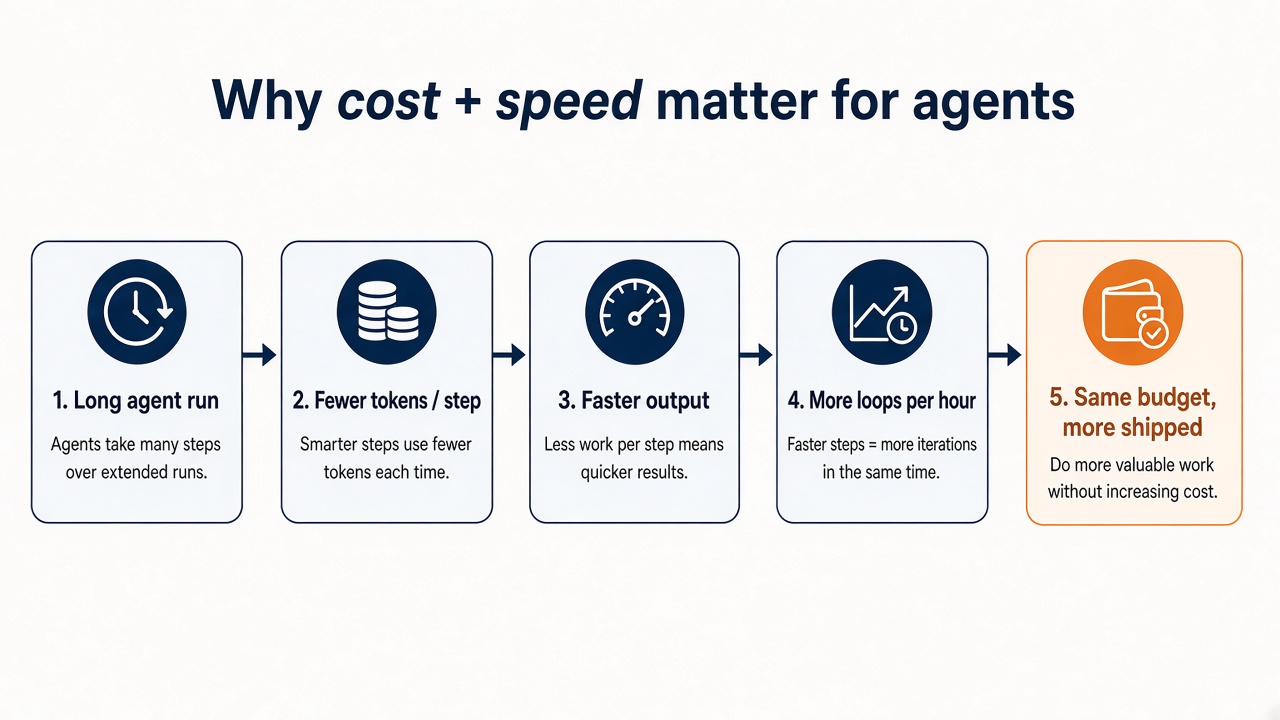
Cheaper tokens mean you can leave a session on medium effort longer. Faster tokens mean each tool call returns sooner, so wall-clock for a 200-step job shrinks. Cleaner writing (Anthropic's other fix after Opus 5 feedback) means less time decoding the model's prose before you approve a change.
That's the excitement, plainly: Opus 5.5 makes "just let the agent cook" economically rational for a wider set of jobs.
Effort, caveats, and the Fable question
A few operator notes so this doesn't read like a press release:
- Default effort is medium (down from Opus 5's high). Anthropic's ~40% workload savings are at default settings — max effort burns a lot more tokens. Third-party notes (including Artificial Analysis coverage summarized by 36Kr) show max can flip the cost/performance story versus Astra if you always crank it. Start medium. Escalate with intent.
- Thinking can't be turned off. Adaptive thinking is always on; you pick low → max effort. Forced tool_choice is gone (auto / none only). Plan for that in API migrations from Opus 5.
- Safeguards are real. Biology and cybersecurity fall back similarly to Fable 5.1; cyber tasks often route to Opus 4.8 unless you're in the verification programs. Don't design a red-team product assuming unrestricted Opus 5.5.
- Fable's positioning got awkward fast. A $10/$50 model that Opus 5.5 beats on several coding benches at 40% of the unit price needs a clear "when Fable still wins" story (raw max-capability niches, specific science benches where Astra still leads). For most agentic coding budgets, Opus 5.5 is the default I'd trial first.
Community threads are already loud on cost and feel — including first-impression write-ups from r/ClaudeAI and practical "just try it" notes on r/codex. Treat anecdotes as sparks; measure on your harness.
How I'd put it to work this week
| Workload | Move |
|---|---|
| Claude Code / Cursor-style agent coding | Make claude-opus-5-5 the default; keep medium effort; reserve max for the hard 10% |
| Long overnight repo work | Lean on cache reads + the speed bump; budget ~40% less than Opus 5 for the same scope |
| Chatty research / long docs | Use the clearer writing; still gate spend with effort levels |
| Cyber / bio R&D | Check verification program access before you promise the model in a design doc |
| Latency-critical UX | Trial Fast mode ($8/$40) only where wall-clock beats the discount |
Bottom line
Opus 5.5 is the first frontier drop in a while where my first reaction wasn't "cool scores" — it was "we can afford to run the agent longer."
Twenty percent cheaper tokens. Sixty percent cheaper cache reads. More than thirty percent faster output. Roughly forty percent less on typical workloads when you also spend fewer tokens per task. And it still leads the coding benches Anthropic chose to put on the page.
Sonnet 5.5 and Haiku 5.5 are coming. For now, if your stack is agentic coding or knowledge work with a real bill attached, this is the model I'd point at first and measure against your own tasks — not against someone else's leaderboard screenshot.
References
Enjoyed this? Let's work together.
I help companies turn AI strategy into shipped, revenue-generating products.